




Organ Donation
Need for Donation
Organ donation is the selfless act of giving organs to save or restore another's life.
Korean Organ Donation Status
Brain- Dead Organ Donation Recipients
Tissue Donation Recipients
Source | Ministry of Health and Welfare 2024 Estimated Population
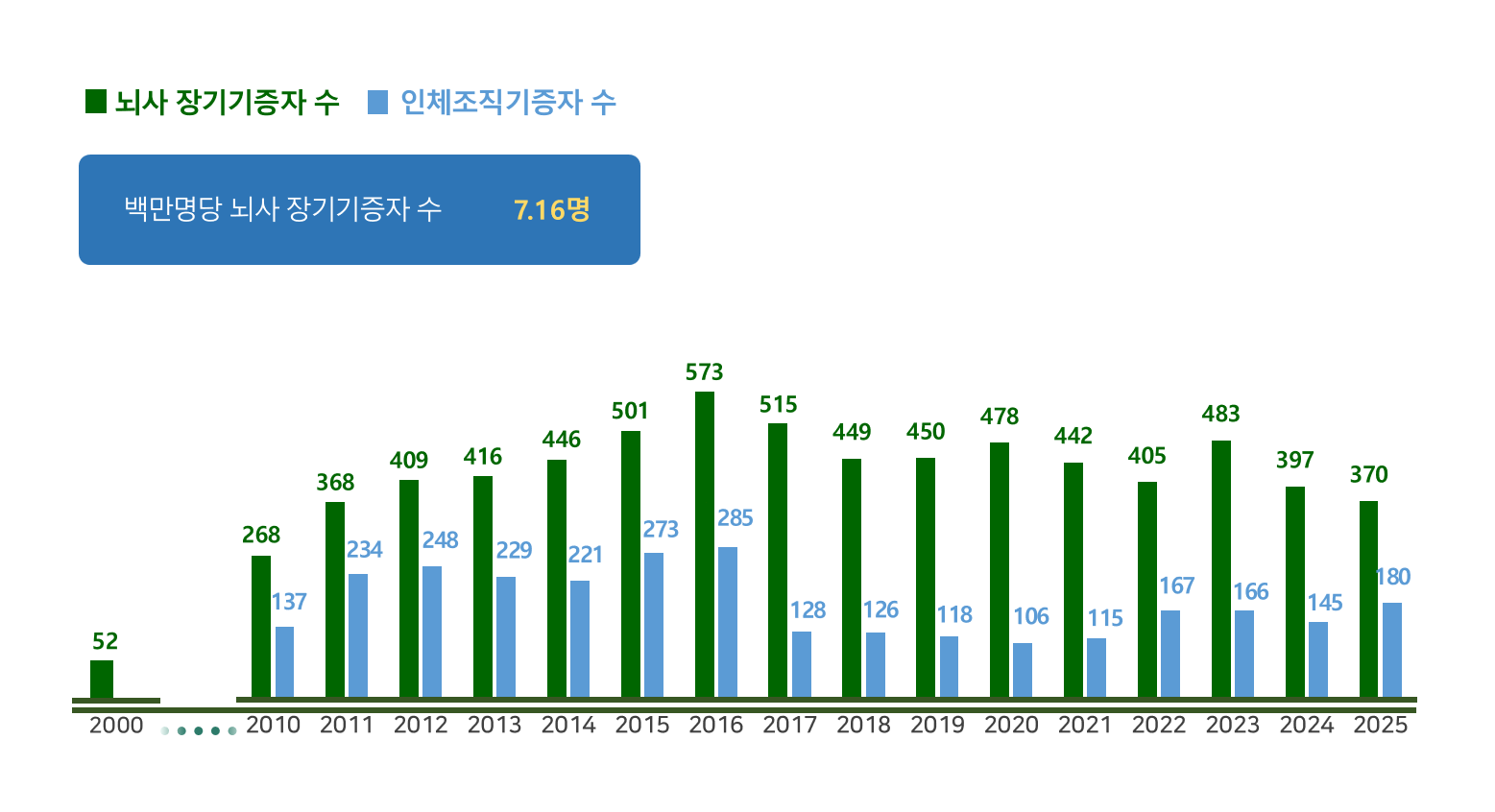
As of 2024, approximately 45,000 people in Korea are waiting for organ transplants. The number of deceased donors is 397, and there are 3,096 transplants performed, meaning 8.4 people die each day while waiting for a transplant.
Global Status of Organ Donation
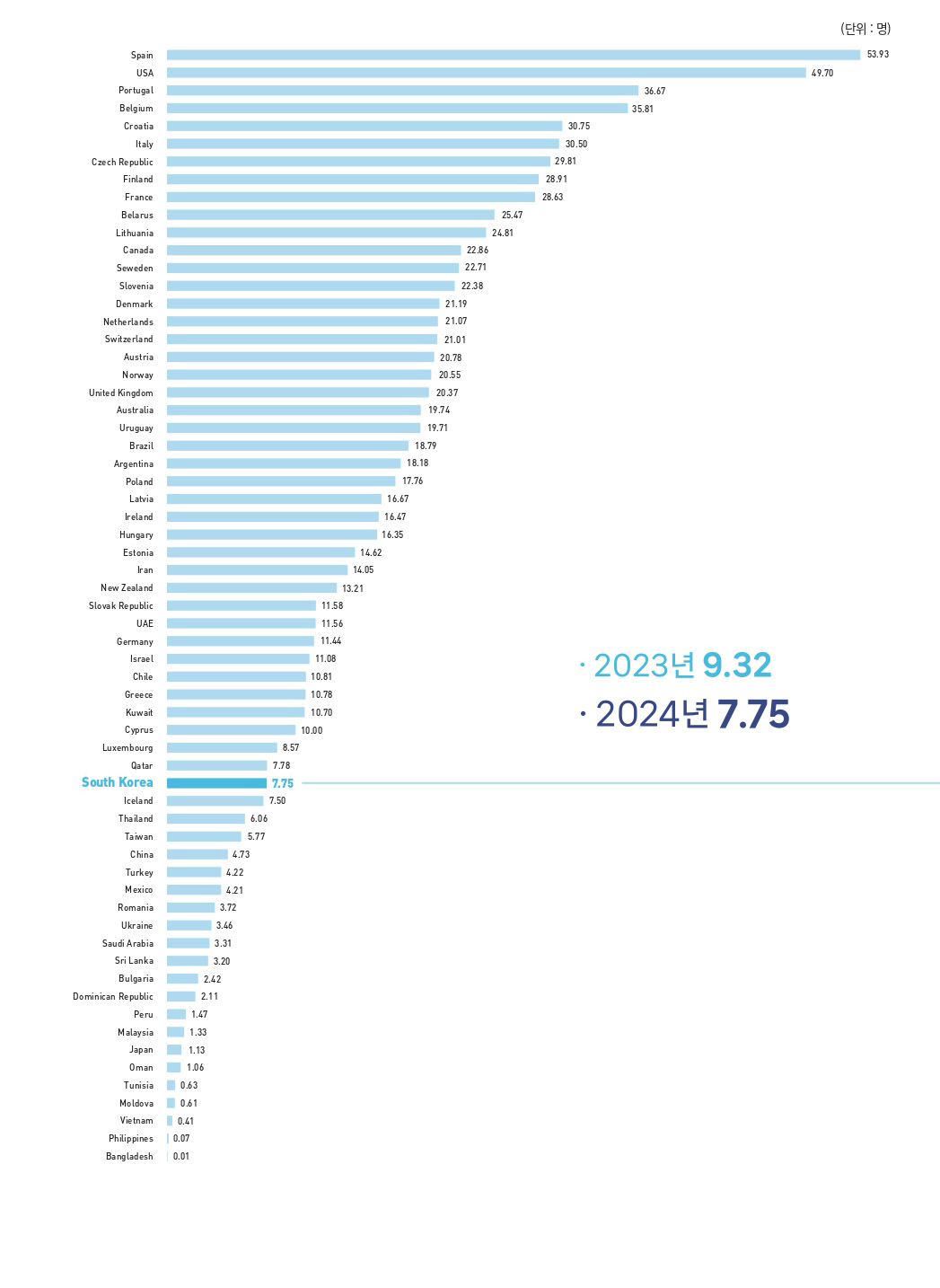
Number of Organ Donations per Million Population (pmp, permillion pupulation) (2023 based)
Source | International Registry of Organ Donation and Transplantation (IRODaT)
Korea records 7.67 organ donors per million people, far below Spain (49.38) and the U.S. (48.04).
Organ Donation
[Article 4 of the Act on Organ Transplantation] Organ donation means giving one's organ to help restore another person's health, without receiving any payment.
Organ Donation after Brain Death
When brain function is completely lost due to an accident or illness, organ donation becomes possible after brain death is confirmed. It offers patients with organ failure a chance for a new life.
Organs That Can Be Donated after Brain Death

Kidneys

Liver

Heart

Lungs

Pancreas, pancreatic islets

Small Intestine

Hands (Arms)

stomach, duodenum, large intestine, and spleen.
Living Organ Donation
Living organ donation refers to the donation of an organ by a living person aged 19 or older to a recipient who may be a spouse, lineal relative, sibling, relative within the fourth degree of kinship, or an unrelated individual.
Organs for Living Donation
Kidney
Liver
Lungs
Pancreas, pancreatic islets
Small Intestine
Brain- Dead Organ Donation
Brain death is the complete and irreversible loss of all brain function due to injury or illness.
Difference Between Brain Death and a Vegetative State
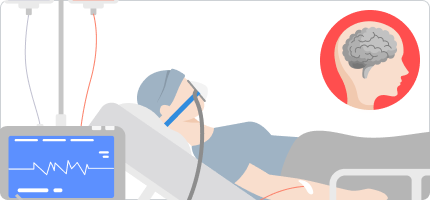
Brain Death
-
Affected Area
Entire brain including the brainstem
-
Loss of Function
Complete loss of all functions, including heartbeat control
-
Movement Ability
No movement at all
-
Independent Breathing
Unable to breathe independently
-
Prognosis
Death, even with active treatment
-
Eligibility for Organ Donation
Eligible for organ donation
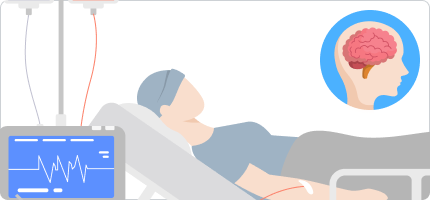
Vegetative State
-
Affected Area
Part of the cerebrum
-
Loss of Function
Impaired memory, thinking, and awareness
-
Movement Ability
Possible limited or reflexive movements
-
Independent Breathing
Able to breathe independently
-
Prognosis
Possible survival or recovery with care
-
Eligibility for Organ Donation
Not eligible for organ donation
※ A vegetative state allows spontaneous breathing and may recover partially within months; therefore, it is not considered a condition for organ donation.
Age Range of Brain-Dead Organ Donors
The youngest donor was 2 months old, and the oldest donor was 86 years old.
Donor Age Statistics for 2024
0-9 years old
9
10-19 years old
13
20-29 years old
36
30-39 years old
37
40-49 years old
73
50-59 years old
105
60-69 years old
95
70-79 years old
26
80-89 years old
3
Total
300
Average
49.6
Source: Korea Organ and Donation Agency (KODA) Annual Statistics Report
Donation Process
Organ donation is allowed after brain death is confirmed.
Brain Death Criteria [Act on Organ Transplantation, Art. 18 / Enforcement Decree, Art. 21]

Preconditions
The cause of brain injury must be clearly identified.
The brain injury must be irreversible and not caused by temporary or treatable conditions.
There must be no evidence of reversible factors such as drug intoxication, hypothermia (below 32°C), or metabolic/endocrine disorders.
The patient must be in deep coma with no response to external stimuli.
Pupils must be dilated and unresponsive to light.

Clinical Criteria
Absence of all brainstem reflexes, including:
Light reflex
Corneal reflex
Oculocephalic reflex
Vestibulo-ocular reflex
Cilio-spinal reflex
Gag reflex
Cough reflex
No spontaneous breathing.
No motor response, seizures, or involuntary movements.
No brain activity indicating potential for recovery.

First and Second Examinations
The interval between the first and second brain death examinations varies by age:
6 years and older: at least 6 hours after the first examination
1 to under 6 years: at least 24 hours after the first examination
2 months to under 1 year: at least 48 hours after the first examination

EEG (Electroencephalogram) Test
A flat EEG must be sustained for at least 30 minutes.
For individuals aged 1 year or older, EEG is performed after the second examination.
For individuals 2 months to under 1 year, EEG is performed both before and after the second examination.

Brain Death Determination Committee
Composition:
The committee consists of 4 to 6 members, including at least 2 medical specialists (one must be a neurologist or neurosurgeon) and at least one non-medical member. Brain death is determined by a majority attendance and unanimous agreement of the members present.
Qualifications:
Members may include licensed medical professionals, lawyers, public officials, educators, clergy, or other respected figures appointed by the head of the medical institution.
Decision:
Brain death is officially confirmed when more than half the committee members are present and all attending members agree on the determination.
Organ Donation Process after Brain Death
-
Hospitals report potential brain-dead patients to the Organ and Tissue Notification Center (1577-1458)
2. Coordinator Action
-
Medical consultation
-
Confirmation of brain-death suspicion
-
Confirmation of compatibility of donation
3. Family Consultation
-
Explanation of the donation process and brain-death determination
-
Guidance on funeral expense support
-
Donor consent procedures
-
Verification of family relationship
-
Provision of emotional support
4. Brain Death Determination
-
①
1st Examination: Confirmation of prerequisites, brainstem reflex tests, and apnea test
-
②
2nd Examination: Identical to the first Examination
-
③
EEG Test: EEG must show flat activity for at least 30 minutes
-
④
Brain Death Committee Review: Including at least one neurologist or neurosurgeon
5. Organ Evaluation
-
Donor evaluation: ultrasound, CT, and blood/genetic testing
6. Recipient Selection
-
Recipient selected by KONOS based on urgency, waiting time, and medical criteria
-
Surgery time coordinated with transplant hospitals
7. Organ Recovery Surgery
-
Organ recovery surgery (average duration: 6–8 hours)
-
If tissue donation is also consented, evaluation and recovery follow
9. Return of Donor to Family
-
Donor's body is then returned to the family